Sovereign audit · cloud · on-prem · AI

Prove where your
data lives. Down to the key.

SovSentry continuously audits your whole estate — cloud, on-prem, and every AI system in between — against the four pillars of digital sovereignty, and hands you signed, auditor-ready evidence that your data, keys, models, and workloads sit exactly where your rules say they should.

You're on the list — we'll be in touch.

Private beta · onboarding regulated teams in the EU & UK first.
Reads, never writes AWS Azure On-prem & private AI & LLM workloads
app.sovsentry.io/dashboard
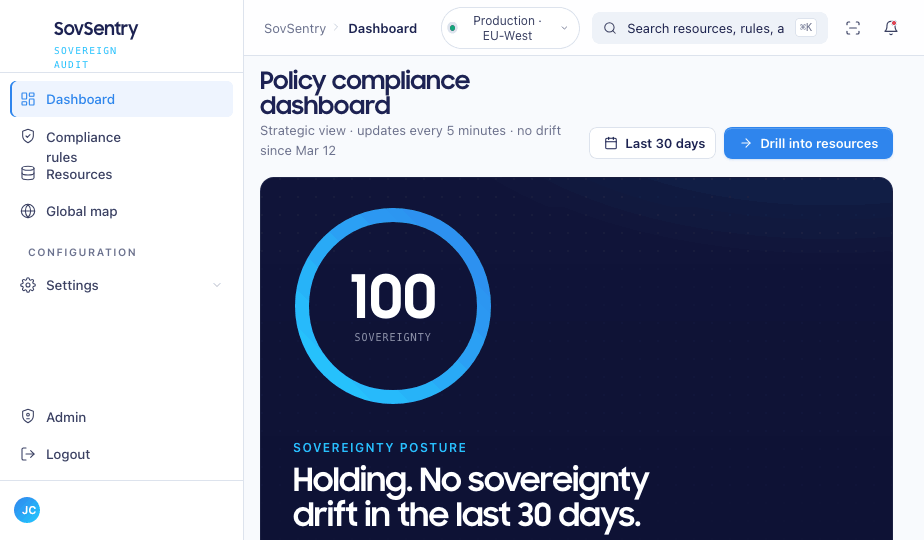
SovSentry dashboard — sovereignty score and compliance posture
The sovereignty gap

Your compliance slides say one thing. Your cloud config says another.

Regulators no longer accept a data-flow diagram from last quarter. They want to see — today — that confidential workloads never touch a jurisdiction you can't control. Most teams can't prove it, because the truth is scattered across hundreds of resources, multiple clouds, their own data centres, and a sprawl of AI systems nobody signed off on.

73%

Evidence is stale on arrival

Sovereignty is asserted in annual reviews and spreadsheets — then drifts silently the moment an engineer spins up a resource in the wrong region.

Shadow AI

AI is moving data off-limits

Teams wire up copilots and LLM endpoints faster than anyone can govern them — quietly shipping regulated data to models and regions that were never approved.

Cloud Act

Legal exposure you can't see

A workload on a US-owned region can be subject to foreign-government access — even when it sits physically in Frankfurt. That risk is invisible in the console.

The four pillars

Sovereignty, measured continuously across every resource.

SovSentry scores your estate against four pillars on every scan, turns each into enforceable rules, and alerts the moment something drifts.

01

Legal immunity

Flag any confidential workload running on infrastructure exposed to foreign-government access — before an auditor, or an adversary, finds it.

  • US Cloud Act exposure mapping
  • Forbidden-region policies by data class
02

Data residency

Pin data to the regions you allow and catch cross-region copies in seconds — not at the next quarterly review, when it's already too late.

  • Per-region drift detection
  • Live jurisdictional exposure map
03

Operational control

Verify that every production key is HSM-backed and under your custody — no silent fallbacks to provider-managed keys, no missed rotations.

  • HSM & BYOK custody checks
  • Rotation & expiry tracking
04

Supply chain

Hold every container image and vendor to an attestation standard, and quarantine anything unsigned before it reaches a sovereign workload.

  • Image signing & provenance
  • Vendor attestation registry
Mapped to the regulation

Every scan maps to the frameworks your auditors already use.

SovSentry rules carry framework references — from data residency to AI governance — so an evidence pack reads like a control matrix, not a wall of raw config.

GDPR
Chapter V transfers & residency of personal data
Schrems II
Third-country access & supplementary measures
EU Cloud Act
Foreign-government access exposure
DORA
ICT third-party & concentration risk
BSI C5
German cloud controls & key custody
SecNumCloud
French sovereignty qualification (ANSSI)
NIS2
Essential-entity supply-chain security
ISO 27001
A.5 / A.8 cryptography & supplier controls
EU AI Act
High-risk AI siting & data governance
ISO 42001
AI management system & model oversight
Questions

What teams ask before they connect.

Does SovSentry need write access to our cloud?
No. SovSentry connects through read-only roles on AWS, a least-privilege service principal on Azure, and a read-only collector for on-prem and private cloud. We discover and score resources — including AI workloads — but never modify, move, or delete anything in your environment.
Where does the evidence and metadata live?
In the region you choose, on EU-controlled infrastructure by default. We store configuration metadata and findings — never the contents of your data stores. Evidence packs are signed so their integrity is verifiable after export.
How quickly does a drift get caught?
Continuous scans run on a schedule you set, with a median time-to-detect of around 42 seconds across sovereignty events. Critical rules — like a forbidden-region copy — can trigger an alert and an auto-resolution workflow the moment they fire.
What does an auditor actually receive?
A signed evidence pack: a point-in-time control matrix mapping each rule to its framework reference, the resources in scope, and the pass/fail state with timestamps. It's built to be handed directly to a regulator or external assessor.
Does this work beyond AWS and Azure?
Yes. AWS, Azure, and on-prem or private-cloud estates are covered today through read-only connectors, and AI workloads are scored alongside everything else. Dedicated sovereign-cloud providers are next — early-access teams help us prioritize which ground-truth sources we add.
How does SovSentry handle shadow AI?
It discovers AI and LLM workloads the same way it discovers any other resource — including the ones nobody registered — and scores them against your sovereignty rules. You see which models touch regulated data, where they run, and which were never approved, so shadow AI surfaces before it becomes an incident.
Private beta

Ship on ground you control.

Join the teams proving their cloud, data centres, and AI are sovereign — continuously, and in front of an auditor. Request access and we'll get you scanning.

You're on the list — we'll be in touch.

No credit card · read-only connection · cancel anytime